Who Speaks for Kashmiri Muslims? A History of Religious Authority, Shrines and Competing Traditions
From Sufi saints and the Mirwaiz institution to Ahl-e-Hadith scholars, Jamaat-e-Islami and Shia clerical families, Kashmir’s religious leadership has never belonged to a single authority
By: News Desk | 29 October 2026
Srinagar: Who speaks for Kashmiri Muslims? The question frequently returns during political controversies, religious disputes and major public events. It is often directed at prominent clerics, the Mirwaiz of Kashmir, religious organisations or influential Shia leaders. Yet Kashmir’s history offers no simple answer.
For centuries, religious authority in the Valley has developed through a diverse network of Sufi saints, shrine custodians, Islamic scholars, hereditary religious families, seminaries, mosques and organised movements. Some leaders have commanded widespread spiritual respect, while others have built influence through scholarship, religious reform, community organisation or political engagement.
Unlike religious systems organised around a single supreme clerical office, Kashmir has never had one institution universally accepted as the representative authority of all its Muslims.
The region’s Sunni and Shia communities have distinct religious institutions and traditions. Within the Sunni community itself, different schools of thought and religious organisations have developed their own networks of scholars, mosques and followers. Even within individual traditions, authority is not always uncontested.
Understanding who speaks for Kashmiri Muslims therefore requires looking beyond contemporary political personalities and examining how religious leadership evolved over several centuries.
Islam in Kashmir: The Influence of Sufi Saints and the Rishi Tradition
The history of Islam in Kashmir is closely associated with Sufi traditions, travelling scholars, spiritual networks and the gradual transformation of local society.
Among the most influential historical figures was Mir Syed Ali Hamadani, popularly known as Shah-e-Hamadan. A Persian Sufi scholar associated with the Kubrawi tradition, he is remembered for his religious teachings and influence on Kashmir’s spiritual and cultural life.
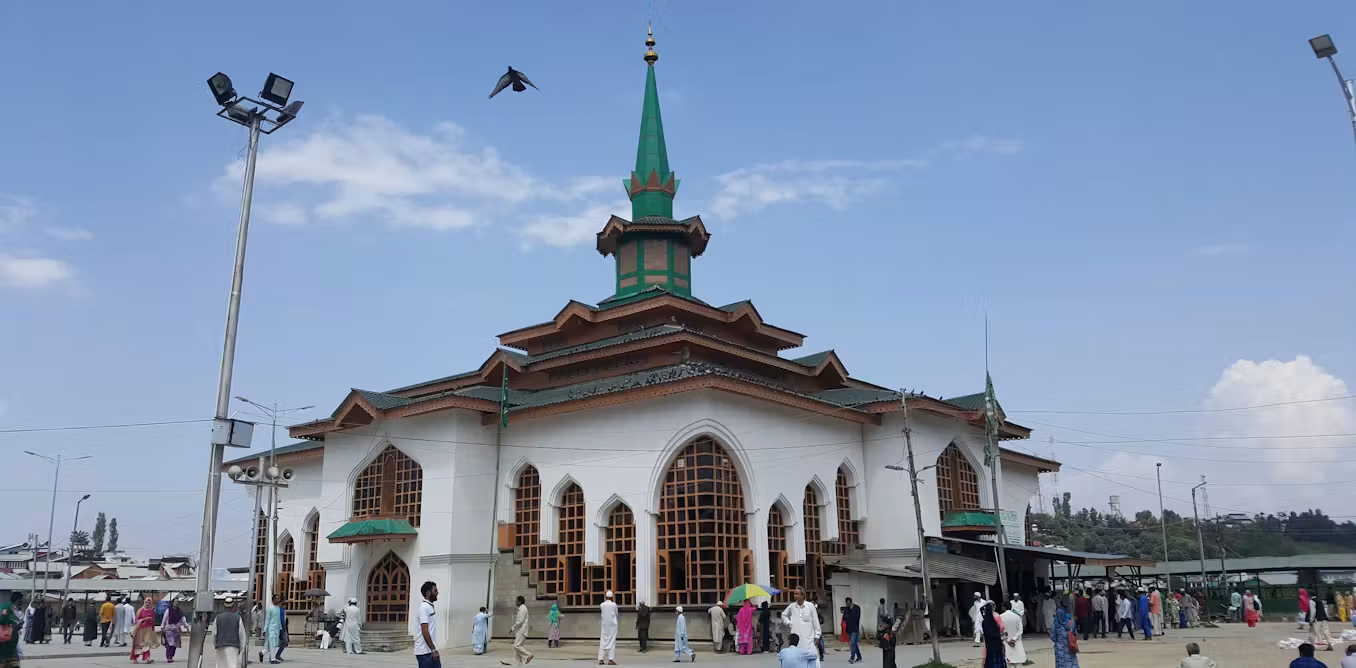
His legacy is particularly visible in the Khanqah-e-Moula in Srinagar, one of the Valley’s most important religious and historical sites.
Another central figure was Sheikh Noor-ud-Din Noorani, widely known as Nund Rishi or Sheikh-ul-Alam. His teachings, expressed through Kashmiri poetry and spiritual instruction, became deeply embedded in the Valley’s religious and cultural identity.
The Rishi tradition associated with Nund Rishi placed considerable emphasis on devotion, humility, compassion, self-discipline and service to humanity. His spiritual legacy continues to influence how many Kashmiris understand their religious and cultural heritage.
The influence of these figures extended beyond formal religious instruction. Shrines, khanqahs and spiritual centres became places where people gathered for prayer, guidance, education and community interaction.
Over time, custodians of important shrines, respected spiritual families and local religious scholars acquired considerable influence. Their authority often rested on spiritual reputation, scholarly learning, family lineage and public trust rather than appointment by a central religious institution.
However, Islam’s spread in Kashmir should not be reduced to the work of a few Sufi personalities. It was a gradual historical process involving several generations of scholars, political developments, migration, local religious traditions and changing social institutions.
The result was a distinctive religious culture in which Sufi spirituality became an important part of Kashmiri Muslim identity.
The Mirwaiz Institution: Kashmir’s Most Visible Religious Office
Among the most recognisable religious institutions in the Valley is the office of the Mirwaiz.
The title Mirwaiz, derived from Persian, is associated with religious preaching and instruction. In Kashmir, it developed into an influential position combining religious, social and, at different points in history, political responsibilities.
The Mirwaiz traditionally delivers sermons at Srinagar’s historic Jamia Masjid, the Valley’s most prominent congregational mosque. The Friday sermon has provided the institution with a public platform from which religious, social and political questions can be addressed.
Over generations, the Mirwaiz family established a strong presence in Kashmir’s religious life. Its influence grew not only through the mosque but also through public engagement, religious education and involvement in community affairs.
The institution became particularly prominent during the twentieth century, when religious leadership increasingly intersected with political mobilisation.
From Mirwaiz Mohammad Farooq to Mirwaiz Umar Farooq
Mirwaiz Mohammad Farooq emerged as an influential religious and political figure during a period of significant change in Kashmir.
In 1964, he founded the Awami Action Committee, a socio-religious political organisation that provided an institutional platform for his public activities.
His role extended beyond religious preaching. He became an important voice in discussions about political rights, identity and the future of Jammu and Kashmir.
Following his assassination in May 1990, his son, Mirwaiz Umar Farooq, succeeded him as the prominent religious figure associated with the Jamia Masjid tradition.
Mirwaiz Umar Farooq has since remained one of the Valley’s most visible Sunni religious leaders. His influence extends into religious discourse, political affairs and public discussions concerning Kashmir.
The Indian Express has documented how the Mirwaiz family’s control of the historic Jamia Masjid pulpit translated into considerable social and political influence, including its longstanding rivalry and political differences with the National Conference leadership.
But the Mirwaiz institution should not be confused with a central authority representing every Kashmiri Muslim.
Its influence is particularly significant among sections of the Valley’s Sunni population. Other Sunni traditions have their own religious scholars and institutions, while Shia Muslims follow distinct clerical structures.
There are also historical distinctions between the Mirwaiz of Kashmir and the Mirwaiz Hamadani lineage associated with the Khanqah-e-Moula. The existence of different religious lineages itself illustrates that religious authority in Kashmir has never been entirely centralised.
The Rise of Religious Reform Movements
The nineteenth and twentieth centuries brought significant changes to Kashmir’s religious landscape.
New Islamic reform movements emerged, questioning established practices and challenging traditional forms of religious authority. They introduced different approaches to Islamic scholarship, religious observance and community organisation.
Among the most influential were:
- Ahl-e-Hadith
- Jamaat-e-Islami Jammu and Kashmir
- Deobandi-influenced religious institutions
- Barelvi and Sufi-oriented organisations
- Traditional Hanafi scholars and local religious networks
These movements did not always agree on religious interpretation, the role of shrines, Islamic jurisprudence or the relationship between religion and politics.
Their emergence made Kashmir’s religious landscape more diverse and, at times, more contested.
Ahl-e-Hadith: A Reformist Movement with Its Own Institutions
The Ahl-e-Hadith movement became an important force in Kashmir from the late nineteenth century.
Its scholars emphasised the Quran and Hadith as primary sources of religious guidance and questioned practices they considered unsupported by these sources. The movement also challenged certain forms of shrine-centred religious practice and hereditary spiritual authority.
One of its important historical figures was Maulana Muhammad Anwar Shopiani, whose religious teachings and Kashmiri poetry contributed to the movement’s growth.
Research published in the Journal of the Royal Asiatic Society by Cambridge University Press traces Shopiani’s contribution to the development of Ahl-e-Hadith in Kashmir. It notes that the movement gradually established its own mosques and institutions, with the Anjuman-e-Ahl-e-Hadith formally organised in 1923.
The movement’s history also reveals that religious competition was not simply a disagreement between theology and spirituality. It involved questions of social influence, access to mosques, religious education and the legitimacy of different scholars.
Today, Ahl-e-Hadith scholars and institutions continue to represent an important strand of Sunni religious life in Kashmir. Their influence is exercised through mosques, religious education, preaching and organised community networks.
Their presence also demonstrates why the Mirwaiz cannot be regarded as the sole religious voice of the Valley.
Jamaat-e-Islami: Religious Organisation and Political Influence
Jamaat-e-Islami Jammu and Kashmir represents another important chapter in the region’s religious history.
Unlike a traditional clerical institution built around a hereditary religious office, Jamaat developed as an organised movement with a wider ideological, educational and social framework.
Its influence grew through religious education, literature, schools, community organisation and political engagement. Over the decades, it developed a distinct role in Kashmir’s public life.
Jamaat’s relationship with electoral politics and the broader political movement in Kashmir has changed across different periods. Its ideological influence has also extended beyond the organisation’s formal membership through its educational and social networks.
The organisation’s legal status is a separate matter from its religious influence. The Union government declared Jamaat-e-Islami Jammu and Kashmir an unlawful association in 2019 under the Unlawful Activities (Prevention) Act, with the ban subsequently extended. Its organisational activities and legal position have therefore been shaped by government action and legal restrictions.
The larger historical point is that Jamaat created a model of religious influence different from that of shrine custodians or hereditary clerics. Its authority emerged through ideology, organisation and social networks.
Deobandi, Barelvi and Sufi Traditions
Deobandi and Barelvi-influenced scholars and institutions have also contributed to the diversity of Kashmiri Sunni religious life.
Deobandi scholarship places considerable emphasis on Islamic learning, religious discipline and the study of classical texts. Barelvi traditions generally place greater emphasis on devotion to the Prophet, reverence for saints and established Sufi practices.
These broad descriptions should not be treated as rigid categories. Religious communities are internally diverse, and individual scholars may have positions that do not fit neatly into simplified labels.
Kashmir’s religious landscape also includes local Sufi organisations, traditional imams, independent scholars and shrine-based networks that do not necessarily belong to a single formal movement.
This diversity is one reason why religious authority in the Valley is better understood as a network of overlapping influences rather than a hierarchy.
Shia Religious Leadership: A Distinct Clerical Tradition
Kashmir’s Shia Muslim community has its own religious institutions, scholarly lineages and leadership structures.
Shia religious authority is traditionally associated with Islamic scholarship, jurisprudence and clerical learning. Prominent scholars may also maintain links with major centres of Shia learning, particularly Najaf in Iraq and Qom in Iran.
In Jammu and Kashmir, the Aga family of Budgam has historically been among the most influential Shia religious families.
The Aga Family and Anjuman-e-Sharie Shian
The Aga family has played a significant role in the religious and social affairs of Kashmir’s Shia community.
Among its prominent contemporary figures is Aga Syed Hassan Mosavi Al-Safavi, a senior Shia cleric and president of Anjuman-e-Sharie Shian.
The organisation has been involved in religious, educational and community activities, while its leadership has also participated in wider political and social discussions.
The Aga family’s influence is not simply political. It is connected to religious scholarship, clerical lineage and community institutions.
Other prominent Shia religious families have also contributed to the community’s leadership. These include the families associated with the late Iftikhar Ansari and Abbas Ansari, among others.
A 2024 report by The Indian Express described the Aga family as one of three prominent Shia clerical families in the Valley and highlighted the religious and political influence of Aga Syed Hassan Mosavi in central Kashmir’s Budgam district.
Religious Authority and Political Leadership Are Not the Same
An important distinction must be made between Shia clerics and political leaders who belong to prominent religious families.
Aga Syed Ruhullah Mehdi, for example, is a senior National Conference politician and Member of Parliament from Srinagar. His family background connects him to an influential Shia clerical lineage, but his current public role is primarily political.
His political influence should therefore not automatically be treated as equivalent to the religious authority exercised by senior clerics.
This distinction matters because religious legitimacy and electoral representation are different forms of public authority. A politician may enjoy considerable support among a community without holding a recognised clerical position.
Within the Shia community, too, no single family or organisation speaks for every believer. Different religious scholars, institutions and community networks exercise influence in different areas.
The Waqf Board: Administrative Authority Is Not Religious Leadership
The Jammu and Kashmir Waqf Board occupies an important position in the administration of religious institutions and endowed properties.
Its responsibilities include the management, preservation and supervision of Waqf properties such as shrines, mosques, graveyards, educational institutions and other assets dedicated to religious or charitable purposes.
The Board is a statutory institution, and its responsibilities are primarily administrative and legal. It plays a role in managing properties, maintaining religious infrastructure and overseeing institutions under its jurisdiction.
The Board’s official website describes its mandate as covering the administration and preservation of Waqf properties and institutions across Jammu and Kashmir.
However, administrative control over a shrine or mosque does not automatically confer religious authority over its worshippers.
A Waqf administrator may be responsible for the management of property, finances and facilities, while the religious guidance of believers may continue to come from local imams, scholars, spiritual leaders or recognised clerical families.
This distinction has become increasingly important in debates over mosque management, shrine administration and the role of religious institutions in public life.
The Waqf Board can exercise statutory authority within its legal mandate. It cannot, simply by managing religious property, claim to represent the theological beliefs or political opinions of all Kashmiri Muslims.
When Religion and Politics Intersect
Religious authority in Kashmir has rarely remained separate from politics.
During the 1930s, religious leaders and organisations became involved in the wider political mobilisation of Muslims under Dogra rule. The Muslim Conference and the National Conference emerged during this period, while different religious leaders developed their own positions on political representation and the future of the region.
The Mirwaiz institution, particularly through figures such as Mirwaiz Mohammad Farooq and Mirwaiz Yusuf Shah, became part of this political landscape.
Over subsequent decades, religious leaders participated in debates about autonomy, identity, constitutional rights and the Kashmir conflict.
The relationship between religious leadership and politics has sometimes strengthened a leader’s public influence. At other times, it has created divisions among communities and organisations.
The political role of religious figures has also varied. Some have pursued mainstream electoral politics, others have supported separatist positions, while many scholars and local imams have focused primarily on religious and community matters.
This history makes it difficult to identify religious authority through political visibility alone.
A leader may be influential in political negotiations without being accepted as a religious authority. Similarly, a scholar may command considerable religious respect without seeking an active political role.
Why No Single Leader Can Speak for All Kashmiri Muslims
The idea that one person or organisation can represent all Kashmiri Muslims overlooks the region’s religious and social diversity.
Kashmiri Muslims do not constitute a single institutional or ideological bloc. They include Sunni and Shia communities, followers of different schools of Islamic jurisprudence, shrine-centred Sufi traditions, reformist movements and people whose religious lives are not defined by membership in any formal organisation.
Their expectations from religious leaders also differ.
Some may look to the Mirwaiz for guidance on religious and social issues. Others may follow Ahl-e-Hadith scholars, Deobandi institutions, Sufi spiritual leaders or local imams.
Within the Shia community, different sections may look to recognised clerics and religious organisations for guidance. Community members may also support political leaders whose views do not necessarily reflect the positions of their religious scholars.
The same person may command considerable influence in one district or community while having limited authority elsewhere.
Religious authority is therefore built through a combination of scholarship, moral standing, spiritual reputation, institutional responsibility and public trust.
It cannot simply be claimed through political office, family background or administrative appointment.
Who Speaks for Kashmiri Muslims Today?
The most accurate answer is that no single individual or institution speaks for all Kashmiri Muslims.
Instead, different religious and social networks exercise influence over different sections of the population.
The principal sources of religious authority include:
- The Mirwaiz institution: A prominent Sunni religious tradition centred on the Jamia Masjid in Srinagar.
- Ahl-e-Hadith scholars: Religious leaders and institutions that follow a distinct reformist approach to Islamic interpretation.
- Jamaat-e-Islami networks: An organised ideological and educational tradition with a long history of social and political influence.
- Sufi and shrine-based leadership: Spiritual figures, custodians and organisations connected with Kashmir’s historic shrines and khanqahs.
- Deobandi and Barelvi scholars: Religious institutions and networks with their own traditions of scholarship and religious practice.
- Shia clerical families and organisations: Established religious leadership structures, including those associated with Anjuman-e-Sharie Shian.
- Independent ulema and local imams: Scholars and religious figures whose influence is often rooted in local communities rather than large organisations.
These groups may agree on certain religious or social issues while holding sharply different positions on others.
The existence of competing voices does not necessarily mean that religious leadership is weak. It reflects a society in which religious authority has developed through several traditions rather than one central institution.
The Continuing Debate: Influence, Legitimacy and Representation
The question of who speaks for Kashmiri Muslims is likely to remain important because religious leaders continue to play a role in public discussions involving identity, social issues, education, political rights and community welfare.
During major controversies, prominent clerics are often expected to issue statements or take positions on behalf of the wider population. But the assumption that one statement represents the views of every Muslim in Kashmir can be misleading.
A more meaningful way to understand religious representation is to ask three separate questions:
Who has religious scholarship? This concerns the learning, qualifications and theological standing of scholars.
Who has community trust? This concerns the relationship between religious figures and the people who seek their guidance.
Who has institutional or political power? This concerns the organisations, administrative bodies and political platforms through which leaders exercise influence.
These forms of authority can overlap, but they are not interchangeable.
The Mirwaiz may hold a prominent religious and public position. A Shia cleric may command considerable respect within his community. Ahl-e-Hadith and Deobandi scholars may guide their own followers, while shrine-based spiritual networks continue to influence religious life across the Valley.
None of these roles, however, establishes an exclusive right to speak for every Kashmiri Muslim.
Kashmir’s religious history suggests that authority has always been negotiated through scholarship, spirituality, institutions and public confidence.
Perhaps the more useful question is not who speaks for Kashmiri Muslims, but whether the different religious voices of the region are being heard, respected and allowed to represent their own communities without being treated as a single political or theological bloc.
That distinction is essential to understanding one of South Asia’s most diverse and historically distinctive Muslim societies.